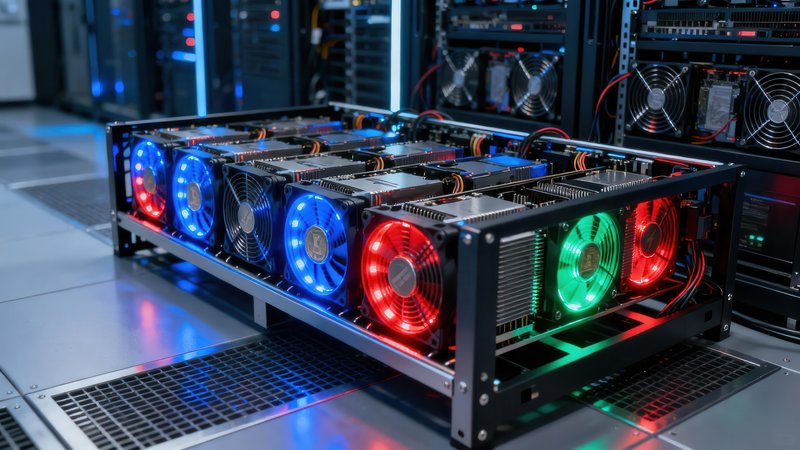
Researchers at UC San Diego have developed a DC-DC converter chip that could address one of data centers' biggest energy inefficiencies: powering GPUs. The chip uses vibrating piezoelectric components instead of traditional magnetic inductors to convert the standard 48-volt data center power down to the 1-5 volts that GPU processors need. Published in Nature Communications, their prototype achieved high efficiency in lab tests designed to simulate modern data center conditions, though specific efficiency numbers weren't disclosed.
This matters because voltage conversion is a massive energy sink that's getting worse as AI workloads explode. Traditional inductive converters struggle with large voltage drops—exactly what data centers face when powering GPUs. As one researcher noted, "We've gotten so good at designing inductive converters that there's not really much room left to improve them." With AI systems already consuming over 10% of U.S. electricity according to the IEA, and demand projected to double by 2030, every efficiency gain counts.
While UC San Diego focused on the hardware solution, other researchers are attacking AI's energy problem from the software side. Tufts University claims they've developed an approach combining neural networks with symbolic reasoning that could slash AI energy use by 100x while improving accuracy—though such dramatic claims deserve heavy skepticism until proven in production environments.
For developers and AI infrastructure teams, this represents a potential future where GPU power delivery becomes dramatically more efficient. But the UC San Diego chip isn't ready for production deployment yet, and the timeline for commercialization remains unclear. Still, with data centers becoming "energy giants" rivaling small cities in power consumption, any breakthrough in power conversion efficiency deserves attention from anyone building at scale.