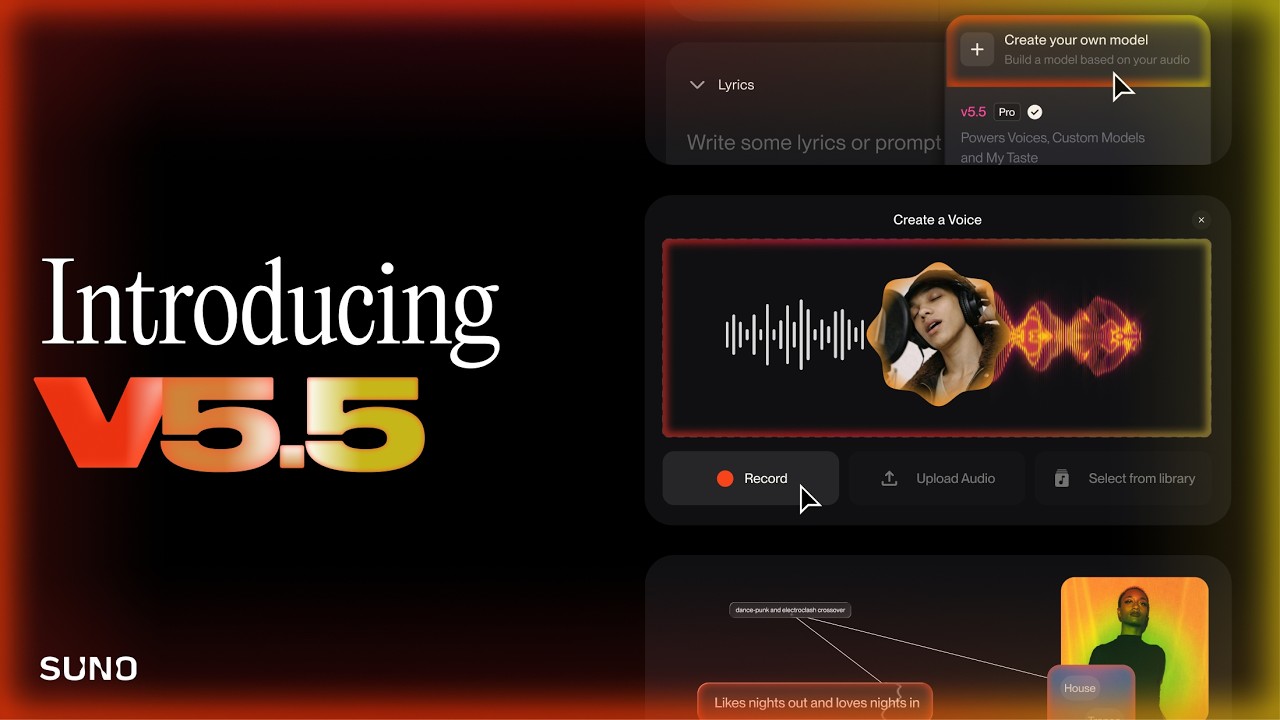
Suno was founded in 2023 by Mikey Shulman, Georg Kucsko, Martin Camacho, and Keenan Freyberg — a team that came out of Kensho Technologies, the AI analytics firm that S&P Global acquired for $550 million in 2018. The founders had spent years working on audio and machine learning problems, and they saw an opening: large language models had made text generation trivially easy, image generation was exploding with Stable Diffusion and Midjourney, but music was still untouched. Their first public release in late 2023 could generate passable songs from a text prompt — lyrics, vocals, instruments, arrangement, production — all in one shot. By early 2024, they had raised a $125 million Series B at a $500 million valuation, led by Lightspeed Venture Partners, with participation from Nat Friedman, Daniel Gross, and Matrix Partners.
How It Actually Works
Suno takes a fundamentally end-to-end approach to music generation. Unlike earlier attempts that stitched together separate models for melody, harmony, rhythm, and vocals, Suno trains on complete songs and generates complete songs. You give it a text prompt describing what you want — genre, mood, lyrics, style — and it produces a full track, typically 2-4 minutes long, with coherent structure including verses, choruses, and bridges. The v3 model, released in early 2024, was the first version that regularly produced songs people actually wanted to listen to more than once. By v4, the quality had improved enough that casual listeners often could not distinguish Suno-generated tracks from human-produced indie music. The model handles dozens of genres, from hip-hop to classical, and supports custom lyrics or can generate its own.
The Music Industry Collision
No AI music company could avoid the copyright question, and Suno ran straight into it. In June 2024, the RIAA filed a major copyright infringement lawsuit against Suno (and competitor Udio), alleging the companies had trained their models on copyrighted recordings without permission. Suno acknowledged using copyrighted music in training but argued it constituted fair use — a legal position that will likely take years to fully resolve. The case became a landmark moment in the broader debate about generative AI and intellectual property, with implications far beyond music. Meanwhile, Suno signed licensing deals with some rights holders and continued iterating on the product, betting that the technology's momentum would eventually force the industry to adapt rather than litigate it out of existence.
The Democratization Argument
Suno's pitch is that music creation should be as accessible as writing a text message. Before generative AI, producing a polished song required years of musical training, expensive equipment, studio time, and often a team of professionals. Suno collapses all of that into a text box and a 30-second wait. For millions of people who have songs in their heads but no way to get them out, this is genuinely transformative. The counter-argument, articulated loudly by working musicians, is that making music "free" devalues the craft and threatens livelihoods in an industry that already underpays most artists. Both sides have a point, and how this tension resolves will say a lot about how society handles creative AI more broadly.
Competitive Landscape and Business Model
Suno operates on a freemium model: free users get a handful of song generations per day, paid subscribers get more generations, higher quality, and commercial usage rights. Their main competitor is Udio, which takes a similar approach but with different aesthetic strengths. Google's MusicLM and Meta's MusicGen are research projects that have not been commercialized as aggressively. Suno has leaned hard into consumer virality — their songs are designed to be shared on social media, and the product has a TikTok-like feed for discovering AI-generated music. As of early 2026, they have tens of millions of users and have generated hundreds of millions of songs, making them the clear market leader in a category that did not exist two years ago.