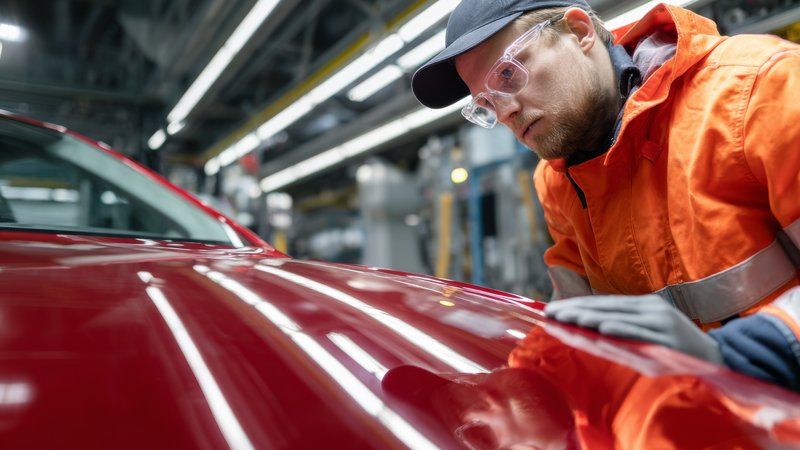
Ford has spent the past three years quietly rehiring around 350 veteran engineers, after the automated quality control systems and AI tools meant to replace them could not keep the company's quality where it needed to be. On its face this reads like another entry in the growing genre of companies walking back AI promises. The actual explanation, offered by Ford itself, is more specific and more useful than that.
Charles Poon, Ford's vice president of vehicle hardware engineering, framed the miscalculation plainly: the company believed it could swap in AI and still turn out a high quality vehicle. The crucial nuance is that the AI was not fundamentally broken. The failure was upstream of the software. Experienced engineers left, through buyouts and attrition, before the institutional knowledge in their heads was ever captured. Decades of hard won judgment about what a subtle design flaw looks like, or which test result is quietly alarming, simply left the building.
That is where the AI made things worse rather than better. Tools trained on data that does not contain that judgment do not somehow reconstruct it. They do the opposite. Without a veteran to flag a weak input, the automated systems treated it as normal and propagated it, amplifying small errors instead of catching them. The technology was confident and fast, which is exactly the wrong combination when the thing it is confident about is wrong. AI is very good at scaling whatever signal it is given, including a bad one.
The fix Ford landed on is the part worth sitting with. It did not abandon the AI, and it did not simply buy more of it. It brought the experienced engineers back to do two things at once. They now run mandatory meetings that rigorously troubleshoot quality problems, they mentor the younger staff who never got the handoff, and they have reprogrammed the AI tools to head off glitches before they reach a customer. In other words, the humans were put back into the loop that trains both the next generation of engineers and the software itself. The expertise had to exist in people before it could be encoded into anything else.
The honest version of this story is mixed, not a tidy redemption arc. Ford came out as the top mainstream brand in the latest JD Power Initial Quality Survey, which suggests the course correction is doing something. But the same company has also led US automakers in recalls this year, issuing 51 so far that cover more than 11 million vehicles, more than double its next closest rival. So this is not proof that AI failed, and it is not proof that rehiring fixed everything. The durable lesson is narrower and harder to dodge. Institutional knowledge that lives only in experienced people does not transfer to a model for free, and a company that removes those people first and hopes the software absorbed them is going to find out, expensively, that it did not. You cannot fire the judgment and keep the judgment.