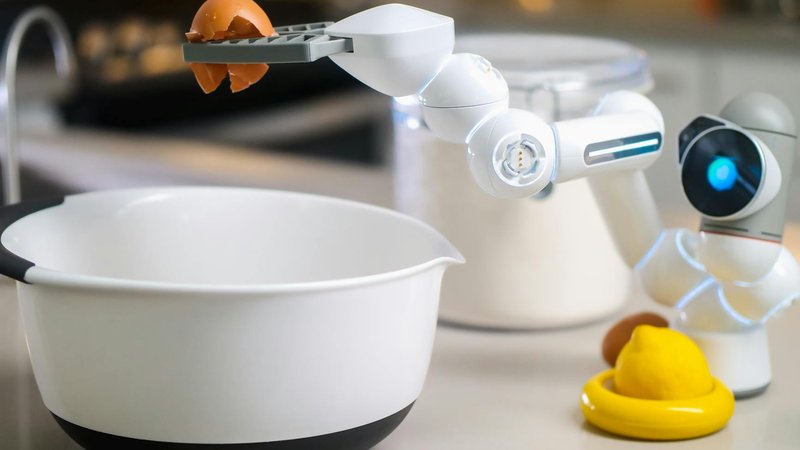
Genesis AI showed its full-stack robotics platform publicly today, with demos covering Rubik's cube solving, cooking (egg-cracking, tomato-slicing, smoothie prep), piano playing, and lab work. The architectural pitch is the bet on human-anatomy hands — robotic end-effectors with proportions matching actual human hands rather than the two-finger grippers most of the industry runs. CEO Zhou Xian's framing: "a better model means better intelligence, but we decided to go full stack" because the embodiment gap (mismatch between training data and deployment hardware) was the bottleneck. The full stack is GENE-26.5 (the foundation model, named after the May 2026 release), custom robotic hands, a sensor-loaded data-collection glove worn during human work, a simulation system for fast iteration, and egocentric video data pipeline. $105M seed (July 2025) from Eclipse + Khosla, with Schmidt, Niel, and Daniela Rus also backing. 60-person team across Paris, California, and London. President Théophile Gervet was previously research scientist at Mistral AI.
The architectural argument is the part to read carefully. Most robotics foundation models train on demonstrations collected via teleoperation or hand-engineered policies on the target robot's specific gripper. Two-finger grippers can't reproduce most human-hand operations (rotational dexterity, fine pinch grips, multi-finger coordination), so the training data is constrained to what the hardware can do. Genesis AI's bet is that designing hands that match human kinematics lets them collect training data via humans wearing the data-collection glove during ordinary work — vastly more available than teleop sessions on robot rigs. The "embodiment gap" framing is well-established in robotics literature; closing it via hardware-side design rather than data-augmentation tricks is the Figure / Physical Intelligence-adjacent playbook. The question that determines whether it works at scale: can human-collected glove data transfer cleanly to robot execution despite the inevitable kinematic and force-profile differences between human hands and robotic ones, even when the proportions match. Demos involving fine manipulation (Rubik's cube, piano, egg-cracking) suggest at least demo-level transfer; production reliability and edge-case handling aren't shown.
The ecosystem read pairs with the Ai2 MolmoAct 2 piece from last week. MolmoAct 2 is the open VLA foundation, with weights and training code planned for release; Genesis AI is the closed-stack opposite, betting on tightly coupled hardware + model + data pipeline. Physical Intelligence (π0/π0.5), Skild AI, Figure (Helix), and NVIDIA Groot are the comparable closed-stack competitors. The bifurcation in robotics is now visible: open-weight foundation models (MolmoAct, OpenVLA, Octo, RDT) competing on accessibility and customizability, vs vertically-integrated stacks (Physical Intelligence, Genesis, Figure) competing on integrated capability and demo polish. For builders training their own robot policies, the open path stays viable because the hardware-specific transfer problem cuts both ways — Genesis's GENE-26.5 won't trivially port to a non-Genesis robot, while MolmoAct 2 weights are architecturally more general. For builders looking to deploy off-the-shelf robotic systems for specific tasks, the closed-stack vendors are the path to capability you can buy rather than train.
Practical move: if you operate in robotics adjacent to commercial deployment (manipulation, food prep, assembly, lab automation), Genesis AI is now the third or fourth name to add to your vendor scan alongside Physical Intelligence, Skild, and Figure. The human-anatomy hand argument is testable: ask whether the data-collection-glove pipeline transfers data fidelity sufficient for your task class, and whether the GENE-26.5 model handles your edge cases at deployment-grade reliability (not demo). If you're training your own VLAs, the egocentric video + glove data approach is the architectural pattern worth examining — even if Genesis's specific hardware doesn't fit your stack, the data-collection methodology may be portable to your own teleop or human-demo pipeline. The longer-term watch is whether human-anatomy hardware actually closes the embodiment gap at scale, or whether it stays a demo-class advantage that doesn't survive the long tail of production failures.