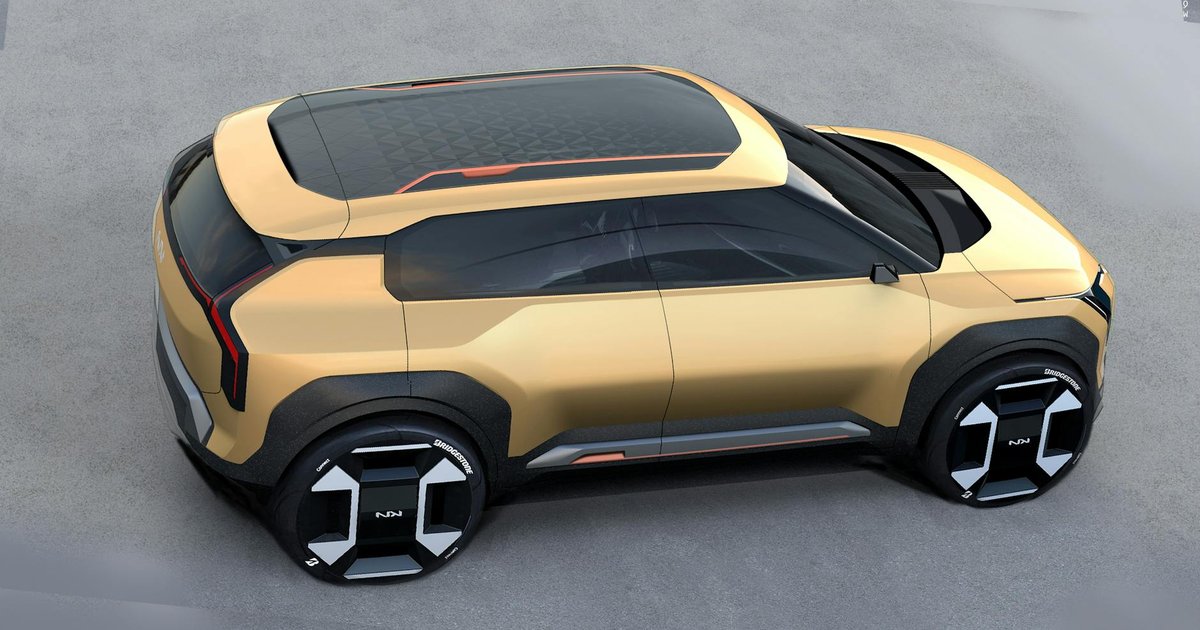
GM rolled out a public look this week at how its design studios are using AI in the production pipeline, and the specific changes are substantive enough to be worth pulling apart from the marketing copy. The headline workflow is sketch-to-3D: a designer draws a futuristic concept by hand, feeds the sketch into AI tooling, and gets back a series of rendered images and short teaser animations showing the concept in 3D motion. Work that used to require multiple teams over multiple months — visualization specialists, modelers, animators — can now be done by a single designer in under a day, without that designer needing extensive 3D visualization skills themselves. The output is not a manufacturing-ready CAD file, and GM is careful to note that downstream engineering still goes through the traditional pipeline. But the front end of design — the iteration loop where you generate dozens of variants, kill the bad ones, and refine the survivors — is now compressed by roughly two orders of magnitude.
The more interesting piece, because it is harder, is the aero work. GM has built an AI-powered tool that serves as a virtual wind tunnel, predicting a vehicle's aerodynamic drag directly from digital renders rather than requiring computational fluid dynamics simulation runs and full-scale physical wind-tunnel testing. Traditional CFD on a complete vehicle takes hours per simulation on dedicated HPC infrastructure, and a physical wind-tunnel run is days or weeks of scheduled time at a shared facility. The AI predictor lets the designer iterate aero choices in real time during the sketch phase, before any CAD model exists. Neural Concept, the Swiss startup whose physics-aware ML platform GM is using here, raised $100M from Goldman Sachs last year on the back of exactly this work and is unveiling a generative CAD capability in early 2026 that takes high-level constraints and produces initial 3D geometry from scratch. That second product is the more disruptive one for downstream engineering pipelines.
The honest read on what this means for the auto industry depends on what you measure. The sketch-to-3D workflow is real productivity gain, not just demoware: GM, Carscoops, and Neural Concept's own writeups all describe the same general workflow with consistent numbers, and the technology is now deployed at scale rather than in pilot. The aero predictor is a step further into territory where AI is replacing simulation, not just augmenting design — and that direction has the potential to compress the design-to-engineering handoff that has historically been one of the most expensive parts of automotive product development. The caveat is that homologation, manufacturing tolerances, crash safety, and regulatory certification all still run on the traditional engineering pipeline, and AI tooling there is much less mature. The cycle time savings are real for the front end and not yet real for the back end, which means the overall vehicle development time is compressed but not transformed.
For builders watching the AI industry from outside automotive, the lesson is that physics-aware ML in industrial design is one of the few clearly working applications of AI in serious manufacturing right now, and the value capture is concentrated in a small number of vendors with domain depth. Neural Concept has Goldman money, GM as a flagship customer, and a roadmap that ends in generative CAD; the moat is the combination of correctly-trained physics priors plus the trust of a conservative buyer base. This is not a transformer-vs-transformer competition where any team with enough GPUs can ship a model. It is a vertical-AI play where the winning company is the one that proves its model produces engineering-acceptable predictions across enough industrial customers, and the early lead compounds quickly. Expect similar consolidation in the AI-for-aerospace, AI-for-pharma manufacturing, and AI-for-energy-infrastructure niches over the next eighteen months.