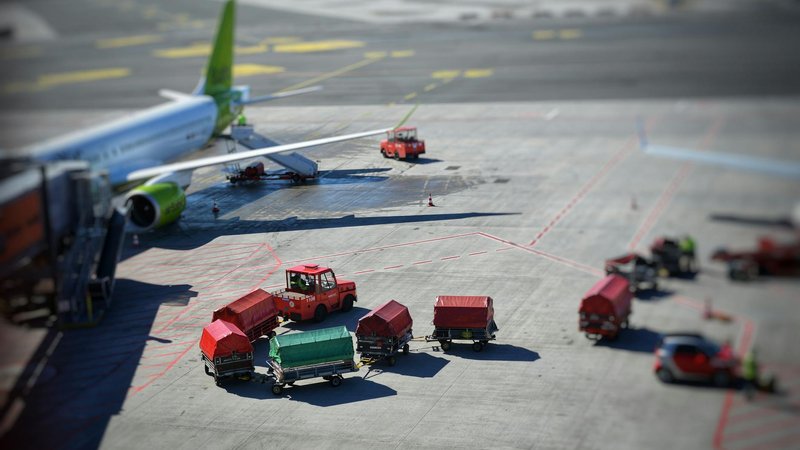
Japan Airlines and its subsidiary JAL Ground Service announced a humanoid-robot pilot at Tokyo's Haneda Airport beginning May 2026, running through 2028. The trial will test Chinese-made humanoid robots — Unitree's G1 (with a baseline price as low as $13,500) and UBTECH's Walker E — on tasks including baggage handling, cargo loading, and possibly aircraft cabin cleaning and ground-support equipment operation. The justification is Japan's deepening labor shortage at airports as visitor numbers surge. GMO AI & Robotics Corporation is overseeing the demonstration with JAL. The first phase of the pilot will identify which airport areas are safe enough for humanoid robots to operate in before any real work begins — Haneda is Japan's second-largest airport, with flights arriving roughly every two minutes.
The reality check is in the demo video. Ars Technica describes one of the humanoid robots in a staged demonstration "tottering up to a large, metal cargo container and making a vague pushing gesture" — and the container moves only after a human worker starts the conveyor belt. That is the current state of humanoid hardware in real environments: Unitree and UBTECH have made the bodies cheap and walkable, but the manipulation, force application, and environmental adaptation are still well below human worker productivity. Most useful robotics in industry today is specialized — robotic arms doing predictable tasks on assembly lines, AGVs running fixed paths in warehouses. The humanoid form factor is harder because the value proposition requires generality: walk into a workplace built for humans, use it as humans would. Generality is exactly where the existing robotic-software stack still struggles.
Two patterns matter. First, the labor-shortage framing is the wedge. Japan has the cleanest demographic story for humanoid deployment — aging population, declining workforce, surging tourism — and that story is being used as cover to test imperfect humanoid systems in production-adjacent environments. Expect the same framing to drive deployments in elder care, retail, and food service through 2027. Second, the hardware is increasingly Chinese. Unitree and UBTECH have driven humanoid hardware costs down by roughly an order of magnitude — Unitree G1 starts at $13,500, versus the $90,000-to-$200,000 range of older Western humanoids. Western humanoid programs at Tesla, Figure, Apptronik, and 1X are now competing against a Chinese manufacturing scale they do not yet have. JAL choosing Unitree and UBTECH is a hardware-vendor decision before it is a robotics-research decision.
For builders near robotics, the takeaways are concrete. If you build manipulation, navigation, or perception models for general-purpose humanoids, an airport is a useful benchmark target — structured and safety-critical, with edge cases (varied luggage shapes, dynamic obstacles, multi-agent coordination) that stress current models. If you build software for industrial automation customers, the JAL-style "we will see if humanoids adapt to human workplaces" pitch is going to show up in your sales conversations whether you sell humanoids or not — be ready to explain how a specialized solution stacks against the generality bet. And if you watch policy: the safety-zone-mapping phase of the trial is where the regulatory shape of humanoid-in-public-space deployment gets defined. Pay attention to what Haneda allows and does not allow — it will get cited.