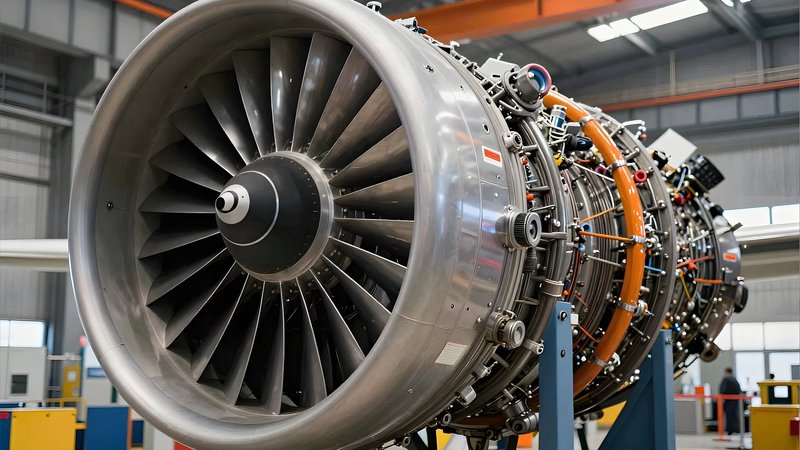
Prometheus, a physical-AI startup co-founded by Jeff Bezos and Vik Bajaj, the former co-founder of Google's life-sciences unit Verily, raised a $12 billion Series B at a $41 billion valuation, the company said June 11. That follows a $6.2 billion Series A launched late in 2025, which means Prometheus has now raised well over $18 billion before describing a shipped product. Its stated goal is an artificial general engineer: software meant to automate the design and the manufacturing of complex physical systems, with jet engines and drug compounds named as the kinds of things it wants to design. The company has about 150 employees across San Francisco, London, and Zurich.
The framing is worth slowing down on, because it is not the one the AI conversation defaults to. This is not a pitch for AGI, general intelligence, but for a general engineer, AI aimed squarely at the design-and-build loop of physical things. That places Prometheus at a different layer of the physical-AI stack than most of what we cover. It is not the robot body, like the general-purpose factory robots raising money the same week, and not the world simulator, like Decart's driving model or DeepMind's Genie. It is the engineering brain one level up: the system that would design the jet engine and the process to manufacture it, or propose the drug compound and the route to synthesize it. Those are high-value, high-complexity design spaces where compressing the design loop is worth enormous money, which is part of why the number is what it is.
The investor list is the clearest signal of what kind of bet this is. Alongside Bezos himself, the backers named are JPMorgan Chase, Goldman Sachs, and BlackRock, Wall Street balance sheets rather than only Sand Hill venture funds. That is how you finance something compute-heavy and capital-intensive rather than software-light, and Bezos indicated a large share of the raise goes straight to compute. His stated worldview frames the ambition: he predicts AI productivity gains will create labor scarcity, a world where demand for workers outruns supply, and that significant productivity in the economy is going to raise the standard of living. That is the optimistic case; the $41 billion is the market pricing the ambition, in advance of the output.
This is the largest single bet yet on physical AI, and it lands in a week that filled in the rest of the thesis around it: world models going commercial, general-purpose robots raising, agents being credited with real scientific work. Prometheus is the maximalist version of the shared idea, that the next frontier is AI acting on atoms, not only tokens. The honest caveat is the distance between the valuation and the evidence. Forty-one billion dollars and 150 people, with the artificial general engineer described as a goal rather than a demonstrated capability, and no shipped product, no benchmark, and no engine designed or compound discovered in the reporting. So the truthful frame is that this is a bet on a vision and a team, priced at frontier-lab scale, by investors with the balance sheets to wait years for it. Whether AI can actually become a general engineer of physical systems is one of the real open questions of the decade. Prometheus just became its best-funded test.