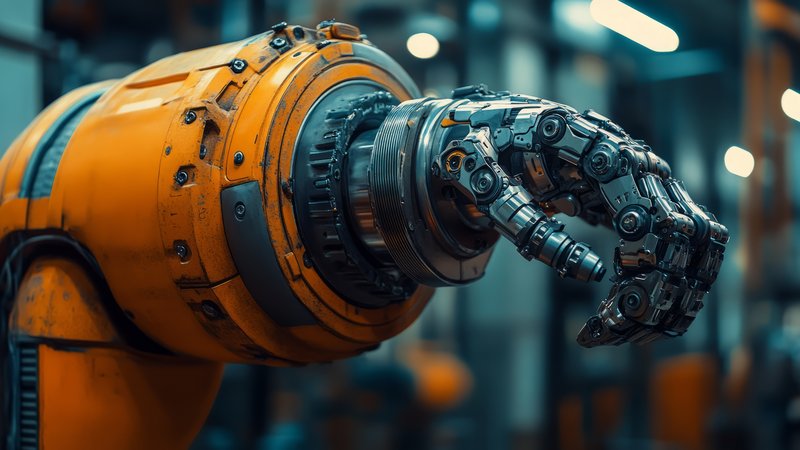
Physical Intelligence shipped π0.5, the next iteration of its generalist robotics policy, on Thursday. The headline claim is zero-shot generalization to new home environments: the same model can control a mobile manipulator to clean up a kitchen or bedroom it has never seen, without fine-tuning. The secondary but structurally important piece is a new robot action tokenizer that trains generalist policies roughly five times faster than the prior method. The release lands inside a tight cluster of robotics-foundation-model news. Generalist AI's GEN-1 (April 2) claims 99 percent success on simple physical tasks with only one hour of robot data per task, trained on a 500,000-hour dataset. Google DeepMind's Gemini Robotics-ER 1.6 (April 15) upgraded the "cognitive brain" layer for embodied reasoning. Three labs, three major releases, two weeks.
The PI action tokenizer is the part to read first. Tokenization breakthroughs were central to how LLMs became tractable to scale: better-chosen tokens means more information per training compute, which lets the model generalize further on the same data budget. The same pattern is now playing out in robotics. The 5x training-speed improvement from a new action-space tokenization is not just engineering convenience, it is the kind of inflection that makes harder tasks trainable. Zero-shot home generalization is the capability demonstration, but the tokenizer is the thing that will show up in every subsequent PI release, and likely in competitors' work. On the broader cluster: Generalist's GEN-1 reports 99 percent success where "previous models achieve 64 percent" on simple physical tasks, and requires only one hour of robot data per task. That is a sample-efficiency claim worth testing against independent evaluation. Gemini Robotics-ER 1.6 is a narrower reasoning-upgrade story and should be evaluated as one component in a full robot stack rather than as a generalist policy on its own.
Robotics foundation models have stopped being an open research question and started being a commercial product category. Two weeks ago the state of the art was "π0 works in the lab." Today it is "π0.5 generalizes to unseen home environments, GEN-1 claims mastery on simple tasks, Gemini Robotics-ER 1.6 is the cognitive-reasoning layer." The competition among PI, Generalist AI, Google DeepMind, and the open-source robotics community (NVIDIA's Isaac releases, the Open X-Embodiment dataset, academic labs) has produced real progress at the capability frontier in a short window. The commercial implication is that anyone building in physical AI now needs to choose which foundation-model lineage to bet on, and the early choices are not obvious. PI is closed-weights, Generalist is similarly closed, Google's releases mix closed and open. The pattern mirrors the LLM space two years ago: capability-pulling labs ship closed, open-source catches up with a lag, and applied builders have to decide whether to take the capability advantage or the control advantage.
Most builders reading this are not shipping robots. For the small minority who are, three concrete observations. First, PI's action tokenizer is the kind of detail that may matter more than the capability demo; watch for whether PI publishes the tokenizer independently or keeps it as a moat. Second, Generalist's "one hour of robot data per task" claim is the sample-efficiency inflection that would make bespoke robot tasks tractable for non-lab teams if it holds under external evaluation. Track for independent replication. Third, if your product involves a general-purpose robot in a human environment (home robotics, logistics, elder care), the speed of this progress means your planning horizon just got shorter. The 2027 capability frontier will be visibly different from the 2025 one, and product positioning that assumed robots would be narrow task-specialists for another five years is wrong. For non-robotics builders, the transferable takeaway is that the "better tokenization unlocks scale" pattern is a recurring deep-learning phenomenon. If your data domain has awkward or inefficient tokenization, fixing that is often a 5x speedup hiding in plain sight.