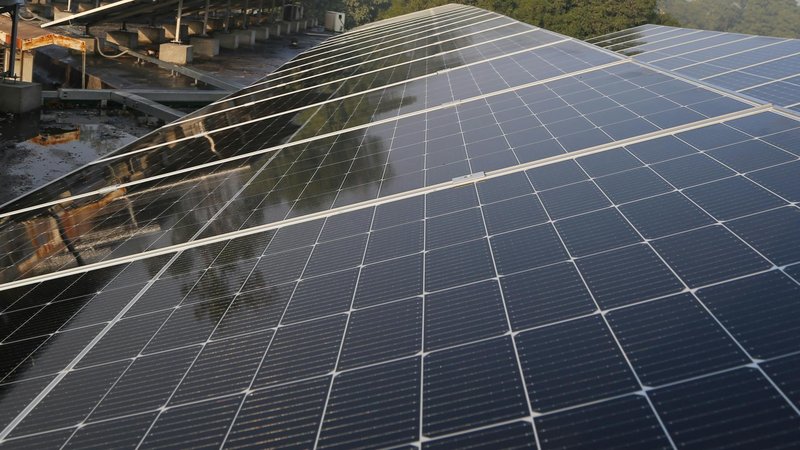
Reliance Industries has committed approximately ₹1.6 lakh crore — about $17 billion at current exchange rates — to build what would be India's largest AI data centre cluster in Visakhapatnam, Andhra Pradesh, with a state-investment-committee-cleared captive solar and battery storage project to power it. The announcement, made through state government and corporate channels on April 28, 2026, breaks down into roughly ₹1.08 lakh crore for the 1.5 GW data centre cluster itself and ₹51,300 crore for the linked renewable installation, which the State Investment Promotion Committee approved at a 9,000 MW DC peak panel capacity and 6,600 MW of AC output. The data centre is described as "fully modular, future-ready" and designed to host the world's most advanced GPUs, TPUs, and dedicated AI accelerators. The Visakhapatnam build is a twin to Reliance's previously announced 1 GW AI data centre in Jamnagar, Gujarat (disclosed January 2025), so when both come online Reliance will operate roughly 2.5 GW of AI-specific compute capacity, putting it in the same scale tier as the largest single-customer commitments anchored in the Microsoft-OpenAI ($250B Azure), Google-Anthropic (5 GW dedicated TPU), and AWS-Anthropic deals announced over the last quarter.
The technical and economic specifics are interesting because the captive renewable design changes the math. A 1.5 GW data centre running on grid-only electricity would face Andhra Pradesh's industrial tariffs and the variability of state-distribution-company supply; pairing it with a 6.6 GW AC solar installation means peak-day generation can substantially exceed instantaneous data centre load, with the surplus going to battery storage for night and cloudy-period use. The 4.4x DC-panel-to-AC-data-centre-load ratio is consistent with sizing for ~24-hour stable operation off the captive plant during reasonable solar weeks; the residual grid dependency exists for monsoon and night-time edge cases. This is the same architectural pattern Reliance is using at Jamnagar and reflects the broader industry pattern (Meta's space-solar projects, Microsoft-Helion, AWS-nuclear) of frontier AI compute increasingly being co-located with dedicated power generation rather than negotiating against the utility grid. The 1.5 GW build also implies on the order of 80,000 to 120,000 H100-class GPUs at typical density (rough estimate, depending on how much is reserved for storage, networking, and cooling), which is comparable to xAI Memphis (~100k GPUs) and within striking distance of the largest Microsoft/Stargate clusters at the upper end.
The broader implication is that India's AI infrastructure tier just moved from "talent hub for US companies" toward "domestic compute provider at frontier scale," at least in announcement terms. Combined with this week's parallel Google announcement of a roughly $15 billion AI hub in Visakhapatnam (also Andhra Pradesh), and the broader pattern of Indian state governments competing aggressively on land allocation, power approvals, and tax incentives for data centre investment, the country is starting to show up in the global AI compute supply chart in a way that matters. The strategic question for the rest of 2026 and 2027 is whether Reliance can actually deliver the GPUs at this scale given the US export-control regime that governs frontier chip sales: Indian firms have been treated more favourably than Chinese ones, but the Tier 2 status under recent rules means there is still a license-and-quota layer between Reliance's announcement and actual H100 or B200 deployments. The captive renewable side is mostly a domestic execution challenge, which Reliance has demonstrated capability on (Jamnagar refinery scale-up); the GPU procurement is the externally-constrained variable. Whether this 1.5 GW lights up in 2027 with H100/H200 generation or in 2028 with B200/B300 generation depends on supply-chain politics that are not in Reliance's hands.
For builders working in or with the Indian AI ecosystem, three things change. First, if you are building products that require AI-specific compute and have data residency or Indian sovereignty requirements, the next 18-24 months will produce two domestic 1+ GW options (Reliance Jamnagar coming online sooner, Visakhapatnam staged through 2028-2030) plus the Google Vizag complex. The procurement question is no longer "do I get capacity in India" but "do I get pricing leverage from competition between Reliance and Google." Second, the captive solar+battery model is going to be the default architecture for new frontier AI builds in regions with good solar irradiance and weak grid stability, which describes most of South Asia, parts of Africa, and parts of the Middle East. The economic playbook (4-6x DC panel-to-load ratio, multi-hour battery, residual grid for edge cases) is now publicly modelled by both Reliance and Meta's space-solar work; teams planning their own AI compute can use these as reference architectures. Third, the geopolitical layer is real: a Reliance-Google duopoly anchored in Andhra Pradesh, plus state-level industrial policy aligned with the Indian central government's AI ambitions, sets up India as the third major AI-compute jurisdiction after the US-Five-Eyes and the China-domestic blocks. Whether that duopoly produces competitive pricing for Indian and South Asian developers is the question the build-out will answer over the next four years.