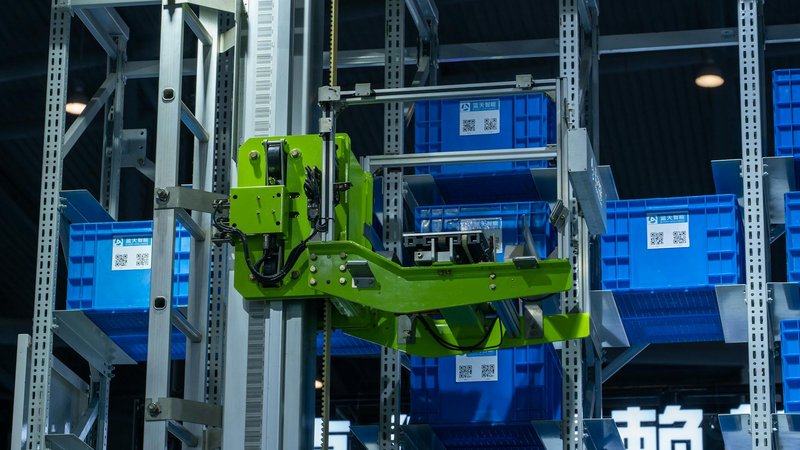
Sereact closed a $110M Series B today led by Headline VC, with Bullhound Capital, Felix Capital, Daphni, Creandum, Air Street Capital, and Point Nine Capital participating; total raised now sits above $140M. The German company, founded in 2021 by Ralf Gulde and Marc Tuscher (former University of Stuttgart AI researchers), sells what it calls Cortex 2.0, a robotics foundation model that converts natural-language instructions into physical actions for industrial and warehouse robots without per-task programming. The interesting architectural point is that Cortex 2.0 explicitly is not a pure vision-language-action model. Instead, the system generates a set of candidate future trajectories from the robot's current state, runs them through a learned physics and object-behaviour world model, and scores each candidate for stability, risk, and efficiency before committing to an action. This is the same approach Yann LeCun has been advocating for years (planning over a learned world model rather than autoregressive prediction over actions) and which DeepMind, Skild, Physical Intelligence, and others have been trialling at smaller scale, but Sereact is the first to publish production-deployment numbers behind it.
The numbers themselves are the actually-interesting part of the announcement. 200+ deployed systems across Europe, 1B+ production picks completed, and a reported 1-in-53,000 escalation rate to human intervention. Named customers are BMW, Daimler Truck, PepsiCo, Bol, and Active Ants, all real industrial and e-commerce logistics buyers rather than pilot-friendly research-institute deployments. The 1-in-53,000 number is the metric to interrogate: industrial robotics ROI hinges on how often a human has to step in, because every escalation is a flow-rate hit and a labour cost. If that number reproduces under independent audit at the same throughput levels Sereact claims, it is a structural step up from the failure rates the previous generation of warehouse robotics shipped at, which is what Headline VC is paying for. The architectural argument for the world-model approach is that scoring candidates against a physics simulator before acting fails gracefully on novel objects (the simulator either rejects unsafe trajectories or routes to human review) rather than confidently doing the wrong thing the way an undertrained VLA can. Whether the architectural difference or the data scale is what produces the deployment numbers is unresolved, but the production data is the new evidence in the VLA-versus-world-model debate.
For builders working on or adjacent to robotics, three concrete things matter. First, the production-data gap between VLA-pure approaches (Physical Intelligence, Skild, Covariant) and physics-informed approaches (Sereact, increasingly Google's ER/VLA split) is now empirically measurable rather than theoretical, and Sereact's numbers are the first real public benchmark. Second, the deployment economics implied by 1-in-53,000 are the threshold above which industrial robotics becomes labour-replacement rather than labour-augmentation, and the 1B+ picks volume is enough to suggest this is not a hand-tuned cherry-picked benchmark. Third, the US expansion through a Boston office is a competitive signal: until now European industrial robotics has trailed US warehouse-robotics deployments (Symbotic, Locus, GreyOrange) on visibility but not necessarily on capability, and a German VLA-alternative entering the US market against Physical Intelligence's home field is exactly the kind of competition that accelerates the industry. The honest builder framing is that warehouse and industrial robotics is now in roughly the same maturity zone autonomous driving was in 2018: real deployments, real numbers, real disagreement about which architecture wins, and the next 24 months will materially separate the survivors. Sereact's $110M just bought it a seat at that table.