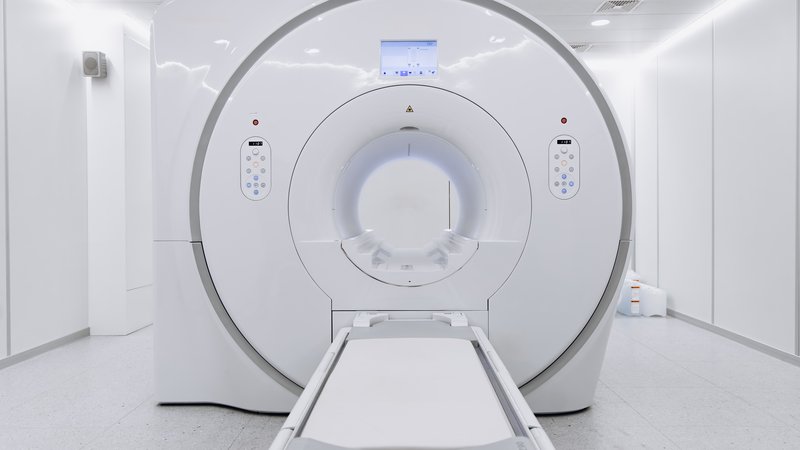
Medical-imaging AI is quietly hitting an inflection point that deserves builder attention. Conventional high-field MRI machines cost one to three million dollars, need liquid helium, demand specialized rooms with heavy shielding, and sit in a handful of hospitals per region. Low-field MRI machines (at field strengths around 0.05 to 0.5 Tesla instead of 1.5 to 3 Tesla) cost a small fraction, run on standard electrical sockets, do not need helium, and fit in smaller facilities. The trade has always been image quality: less signal, more noise, lower resolution. AI is now closing that gap. Published clinical studies report AI-enhanced low-field MRI producing results on par with conventional machines across roughly 100-subject cohorts for specific imaging tasks. A 0.05T reference machine documented in the literature pulls around 1,800 watts, comparable to a hair dryer.
The AI layer does three things. First, super-resolution reconstruction trained on paired low-field and high-field scans lets models upsample noisy low-field data toward the quality of premium hardware outputs. Second, denoising diffusion and transformer-based methods clean the lower signal-to-noise ratio without introducing the hallucinated anatomy that early GAN-based approaches produced. Third, reconstruction models trained on specific anatomies (brain, lung, musculoskeletal) compensate for the reduced contrast of low-field physics by leveraging anatomical priors. Major vendors have shipped this under different brand names: Siemens Deep Resolve, GE's Effortless Imaging AI, Hyperfine's Swoop portable system. Independent academic work has replicated the core result on open datasets. The caveat is that AI-reconstructed images are diagnostically usable for well-studied anatomies and common pathologies. Rare findings, unusual presentations, and anatomies under-represented in training data are where the reconstruction risks breaking down, and the regulatory picture around this is still settling.
This is a pattern worth naming because it keeps recurring. Smartphone cameras displaced point-and-shoots not because small sensors caught up in physics but because computational photography (multi-frame fusion, deep denoising, semantic segmentation for portrait mode) beat the physical quality gap. Noise-canceling headphones did the same for audio. Now AI reconstruction is doing it for medical imaging. The generalizable claim is that when a physical measurement is noisy, low-resolution, or expensive, a neural network trained on paired high-quality references can often bridge the gap at a fraction of the hardware cost. This works wherever the signal has enough structure for a model to infer what the expensive version would have produced, which is most biological and physical-world signals. It does not work where the signal is genuinely information-sparse at the cheap sensor level, because no prior can invent data that was never captured. For builders, the useful rule is to always ask whether your hardware cost is paying for physics or for convenience, because the second one is often replaceable.
If you are building in medical imaging, the practical question is which regulatory path your specific low-field plus AI stack clears; the FDA has cleared several vendor systems, but the burden is per-model and per-indication, so prototyping against cleared reconstruction APIs is usually faster than building your own. If you are building in hardware-adjacent AI more generally, three concrete heuristics follow. One, look for domains where premium hardware costs 10x to 100x more than budget hardware and ask what physical quantity is actually being measured differently; if it is signal-to-noise rather than fundamental sensitivity, AI reconstruction is probably viable. Two, pairing data is the moat, not the model; whoever has a large corpus of paired cheap-and-premium measurements for the domain ships the reconstruction first. Three, the hardware platform you prototype against matters less than the training data you can access; a cheaper sensor with a friendly API beats a more capable sensor with a locked data path every time. Medical imaging is the most visible instance of this shift right now. Similar dynamics are starting to apply to microscopy, satellite imagery, and industrial inspection, and the same builder logic transfers.