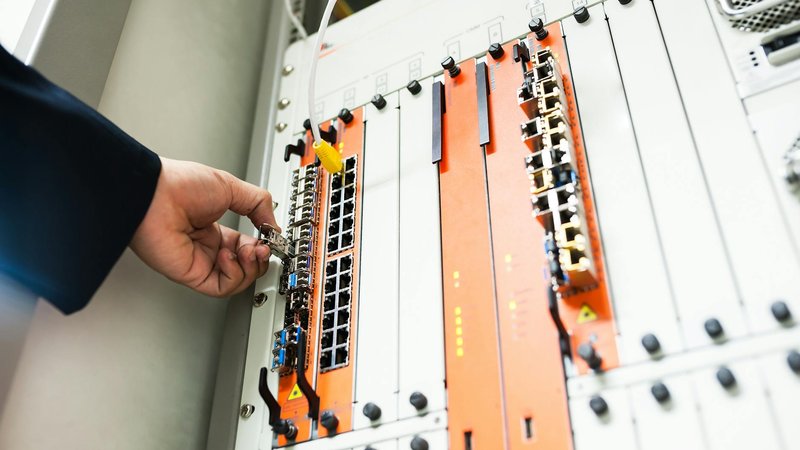
Astera Labs unveiled Scorpio X-Series today, a memory-semantic smart fabric switch built for scale-up AI compute clusters. The headline number is 320 lanes of PCIe 6 per chip, with simultaneous support for NVLink Fusion, UALink, and open-standard fabrics. The company calls it the largest open memory-semantic fabric switch in the industry — the framing matters because the alternative most builders run today is NVIDIA's proprietary NVLink Switch, which has been the de-facto standard for GPU-to-GPU connectivity at trainings beyond a single rack. Scorpio is the first commercial-scale answer from the UALink-aligned camp.
The architectural choice that distinguishes Scorpio is memory-semantic addressing rather than packet-based. GPUs access fabric-attached resources using load/store operations the same way they reach local HBM — eliminating the packet-translation overhead that adds latency on Ethernet-based fabrics. Astera pairs this with proprietary "Hypercast" and in-network compute primitives that run collective operations (all-reduce, all-gather, reduce-scatter — the heart of distributed training) directly on the switch silicon rather than bouncing data through GPU memory. The claim is 2x faster collectives, which if it holds is the kind of number that changes training-economics math at the multi-thousand-GPU scale. The companion P-Series PCIe Fabric Switch family (32-320 lanes) handles the front-end network and smaller AI compute system deployments. Specific port count, total bisection bandwidth, latency-per-hop, and competitive numbers vs NVIDIA NVLink Switch 4 weren't in the launch coverage — those are the next questions that matter.
The ecosystem read is that the UALink consortium just got a flagship silicon product. AMD, Intel, Broadcom, Cisco, Google, Meta, Microsoft, and others backed UALink in 2024-2025 as the open-standard answer to NVLink, and the question has been who ships actual production-grade switching silicon for it. Astera Labs is now that vendor. For neoclouds and hyperscalers building out alternative-to-NVIDIA training clusters with AMD MI300X/MI400 or Intel Gaudi or custom silicon, Scorpio is the missing piece — open-standard memory-semantic fabric that lets you build a competitive scale-up domain without buying NVLink Switches alongside your H100s. For NVIDIA, this doesn't displace NVLink in the near term — Hopper/Blackwell systems are NVLink-native — but it materially changes the moat. Customers buying compute will increasingly have a credible non-NVIDIA stack including the fabric layer, which has been NVIDIA's unique architectural lock-in beyond the GPU itself.
Practical move: if you're operating training infrastructure or a neocloud, Scorpio's spec sheet is worth pulling for your Q3/Q4 hardware roadmap reviews. The 2x collective-speedup claim needs to be validated on your actual workload — collectives are workload-dependent, and the gain will look different for dense MoE training vs RecSys vs LLM pretraining. If you're an AMD-shop or considering MI400-class deployment, Scorpio is the fabric you can actually buy that lets your scale-up domain compete with an NVLink-centric NVIDIA cluster on raw GPU-to-GPU bandwidth and latency. If you're consuming compute through providers (most builders), this matters indirectly: your provider's choice of fabric vendor flows through to per-GPU-hour pricing. Watch which neoclouds adopt Scorpio over the next two quarters; that's where pricing pressure on NVIDIA's NVLink-Switch tax will start showing up.