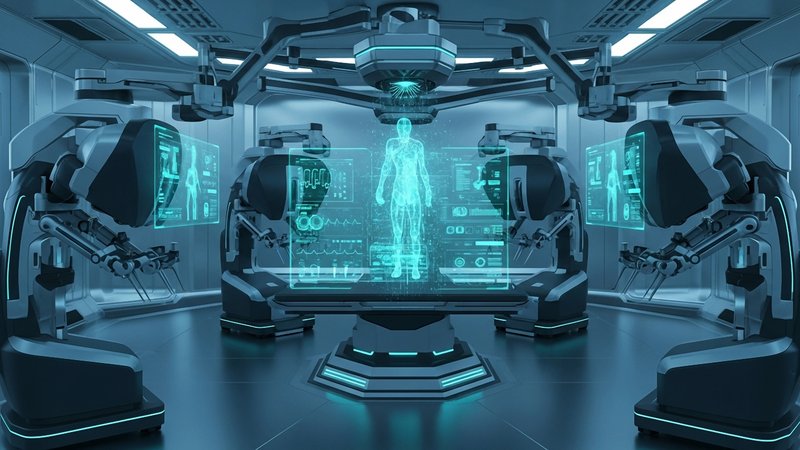
Midjourney, the company best known for turning text prompts into images, has announced its first piece of physical hardware and a new division to go with it, Midjourney Medical. The product is a full-body ultrasound scanner that the company says can map your body in three dimensions in under a minute, and the pitch is as strange as it is ambitious, because Midjourney plans to put the machines not in hospitals but in its own chain of spas. It is a dramatic leap for a firm that has never built a physical product or operated a medical device.
The device, called the Midjourney Scanner, uses a ring of roughly 500,000 ultrasonic transducers, each described as the size of a grain of sand, that send sound waves through the body from every angle and record what comes back to reconstruct a 3D map down to a fraction of a millimeter. Midjourney says a single scan takes less than 60 seconds, against the 60 to 90 minutes of a traditional MRI, which it frames as nearly a hundred times faster, and because it relies on ultrasound rather than X-rays it exposes you to no ionizing radiation. The company has also floated a price on the order of a few dollars per scan.
The delivery model is the strangest part. Instead of selling to clinics, Midjourney intends to open its own Midjourney Spa, starting in San Francisco, where the scanner would sit among hot tubs, saunas, and cold plunges and you would descend into a shallow pool of light to be imaged. The stated ambition is enormous, with the company pointing to 50,000 scanners worldwide by 2031 and, it says, on the order of a billion scans a month. It reframes a medical scan as a wellness ritual rather than a clinical procedure.
The claims are extraordinary and the track record is nonexistent, which is the part to hold onto. Midjourney has never shipped hardware, never run a medical device, and the scanner has no regulatory clearance; the company says it intends to pursue FDA diagnostic approval but does not have it. There is no published independent validation of the resolution or speed claims, no peer review, and no clinical data. A machine that images your whole body and gestures at spotting disease is a regulated medical product, and comparable to MRI is a claim that has to be proven rather than announced.
The announcement lands in a week already thick with AI reaching into medicine and science, from a model that matched doctors on managing illness to one that helped improve a chemistry reaction, and it shares their shape: a dazzling demonstration and a long, unproven road to the clinic. It also sits oddly against this week's polling that most people are wary of AI, since whether the public wants to step into a pool of light to be scanned by an image-generation startup is its own open question. For now it is a vision, a render of a future, which is a fitting product for a company whose entire business is making convincing pictures of things that do not yet exist.