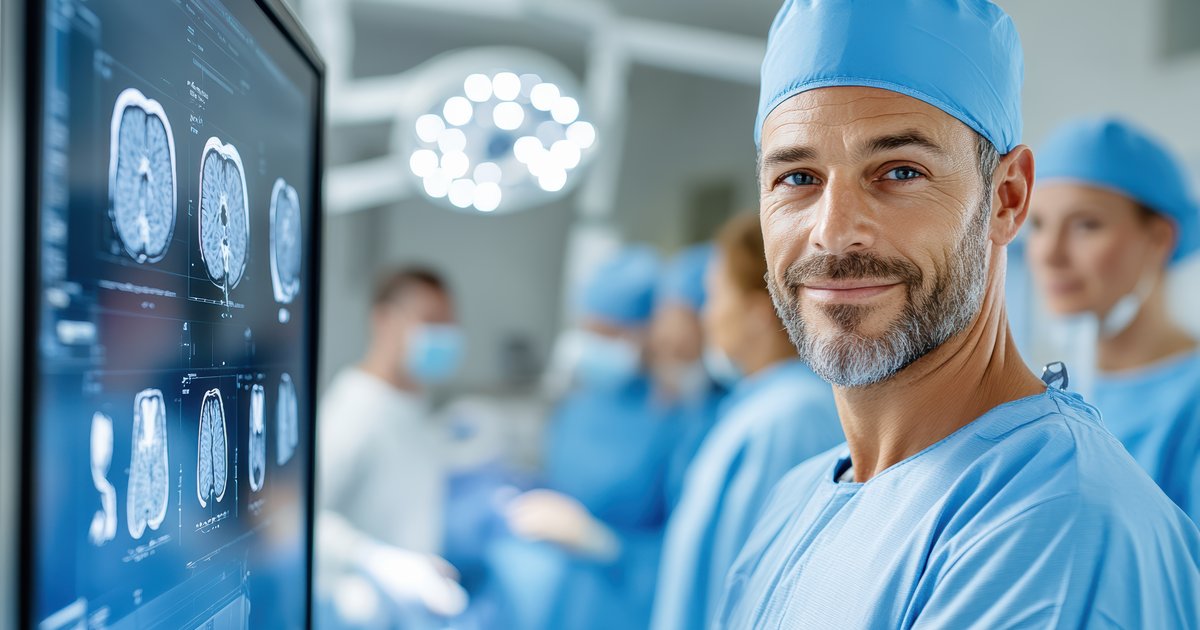
Rhys Hibbert was 48, fit, and taking his usual two mile walk at lunchtime when he fell unconscious in the road and began having a seizure. The scan found an 11mm tumour, non cancerous, growing on his pituitary gland at the base of his skull. That was 2024. By this spring his peripheral vision had narrowed, he was tripping over things, exhausted and dizzy, and facing the loss of his sight. In May, surgeons at the National Hospital for Neurology and Neurosurgery in London removed the tumour through his nose, with an artificial intelligence system watching the operation as it happened. University College London Hospitals kept it quiet until Thursday, while he recovered. It is the world's first AI assisted removal of a brain tumour.
The system did not read his scans. It read the live video feed from the endoscope, a camera on a thin stick threaded up through the nostril to the base of the skull, and displayed its analysis on a second screen. It tracked the surgical instruments, marked the areas where blood vessels and nerves were most likely to be hiding behind bone and membrane, and colour coded the structures that must not be touched. The pituitary gland sits packed against the carotid arteries that feed the brain and the optic nerves that carry sight. Health officials put it plainly: going a millimetre wrong can mean blindness, stroke or death. Even in expert hands the baseline numbers are sobering. There is a 25 to 50% chance of not getting the whole tumour out, and a 0.5 to 2% chance of injuring a major vessel.
Here is the number that explains why this was built. The average UK surgeon performs this operation 10 to 20 times a year, and prepares by studying scans taken before the patient is on the table. Anatomy differs from person to person, so what they are navigating on the day is always slightly new. The AI was trained on hundreds of recorded pituitary tumour removals, with researchers tracing around every vessel and nerve by hand, frame after frame, to teach it what to look for. "By learning from hundreds of surgical videos, it has been exposed to a breadth of surgical examples that would take a surgeon many years to encounter," said Dr Sophia Bano, an associate professor in robotics and AI at UCL and the technical lead for the system. Prof Hani Marcus, who helped perform the operation, put it more bluntly: "It is trained on more operations than most surgeons see or do in a lifetime and can act like an expert second pair of eyes."
The same team published the groundwork in npj Digital Medicine in November 2024, and that paper contains a finding worth sitting with. When they measured how much AI assistance improved the identification of the sella, the bone cavity that holds the pituitary gland, medical students improved by 12.8 percentage points. Experts improved by 1.2. The tool is not making the best neurosurgeons better. It is closing the distance between the surgeon who does twenty of these a year and the surgeon who has done thousands. In a health service where the scarce resource is experience rather than skill, that is arguably the more useful direction to push, and it is a very different claim from the one the phrase "AI brain surgery" invites you to make.
What has actually happened is one operation, on one patient, inside a clinical trial funded by the National Institute for Health and Care Research and by Google. A larger trial is being prepared. Marcus describes the long term ambition as a kind of ChatGPT for surgeons, "another expert in the room they can turn to for advice if they want it, or leave if they disagree with it," and an ambition is not a product. The surgeons kept full control throughout, a point the team repeats carefully. The last word belongs to Hibbert, who agreed to go first: "If patients are not prepared to join research how can doctors ever learn and how can medicine ever progress?" Eight weeks on, his sight is still improving every few days. "It's given me my life back," he said.